
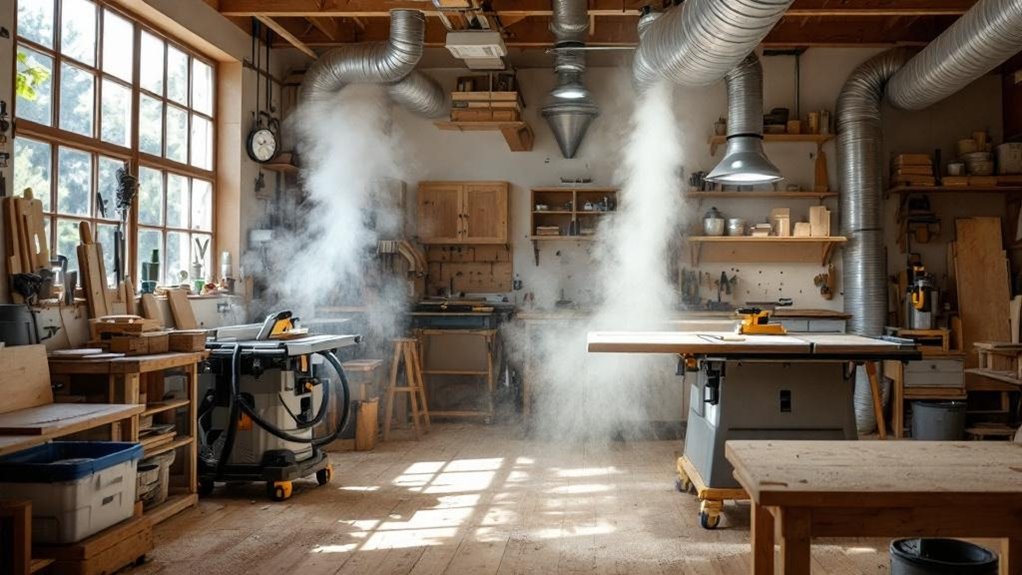
For a small workshop, you’ll usually get the best results from a two-part setup: a shop vac for handheld tools and cleanup, plus a 400+ CFM dust collector or cyclone for stationary machines. Shop vacs handle localized dust well, but they lose airflow fast on longer runs. Dust collectors move more air, capture fine dust better, and keep airborne particles lower. If you want a system that actually fits your shop, there’s more to optimize next.
Key Takeaways
- For handheld tools and cleanup, a shop vac is the cheapest, simplest option, but it offers limited airflow and dust capture.
- For table saws, planers, and other stationary machines, a dust collector with 400+ CFM is usually the better choice.
- Two-stage cyclone collectors work best for high-volume dust because they separate chips first and keep filters from clogging quickly.
- Use short, straight duct runs, sealed connections, and blast gates to maximize airflow and reduce pressure loss.
- Fine dust is a health risk, so prioritize HEPA or efficient filtration if you want safer air in a small workshop.
Which Dust Collection System Works Best?
If you have longer runs or multiple stations, a two-stage cyclone dust collector works better because it separates chips before filtration and captures fine dust down to 1-2.5 microns. That improves air quality and cuts respiratory exposure.
You should also verify airflow; 400 CFM or more helps keep dust suspended, especially with planers and table saws. Portable dust extractors with HEPA filtration can offer flexible setup and very high particle removal, so you can match performance to your shop’s spacing and workload.
Shop Vac vs Dust Collector
When you compare a shop vac and a dust collector, the key difference is suction volume: shop vacs deliver strong localized suction, while dust collectors move much higher CFM for bulk chip and fine-dust removal.
You’ll usually use a shop vac for handheld tools and cleanup, but a dust collector fits stationary machines that generate continuous debris.
Cost and setup also matter, since a shop vac is cheaper and simpler to deploy, while a dust collector requires more space and a dedicated collection layout.
Suction Power Differences
Shop vacs and dust collectors differ sharply in suction capacity: a typical shop vac delivers about 50 to 150 CFM, while a dust collector can move 400 CFM or more. You can see the gap in suction power, motor output, and airflow stability below.
| Type | CFM Range | Motor HP |
|---|---|---|
| Shop vac | 50-150 | 0.5-2 |
| Dust collector | 400+ | 1-5 |
| Dust extractor | Mid-range | Varies |
| Cyclone dust collector | High | 1-5 |
| HEPA extractor | Mid-high | Varies |
If you need sustained airflow, dust collectors outperform shop vacs by moving larger chip loads and fine dust efficiently. Their two-stage cyclone design separates debris before filtration, reducing clogging and maintaining suction. In contrast, shop vacs lose performance faster under continuous demand, so your airflow falls sooner.
Best Uses For Each
For that reason, the right choice depends less on raw airflow alone and more on the task you’re trying to control.
You should use a shop vac for handheld tools, edge sanding, and quick cleanup because it moves easily, connects fast, and handles small dust loads well. In tight spaces, that flexibility makes it practical for general shop maintenance.
You should choose dust collection systems, especially a two-stage cyclone, for table saws, planers, and other stationary machines that produce heavy chips plus fine dust. These systems deliver higher CFM and keep capture performance strong at the source.
In practice, the shop vac suits intermittent, localized work, while a dust collector fits continuous, high-volume machining where air quality and operator exposure matter most in your workshop.
Cost And Setup
Cost is often the first filter, and a shop vac usually wins on upfront price, with typical systems ranging from about $50 to $300.
For your workshop, that lower cost makes sense when you’re collecting dust from small tools or short, localized tasks. The setup is usually straightforward: connect the hose, add minimal ductwork, and you’re working.
A dust collector changes the equation; it typically costs $300 to over $1,000 and may need more ducting, fittings, and layout planning, which raises total cost. In return, you get higher CFM, better filtration, and stronger performance for multiple machines and continuous use.
If you need simple setup and low cost, choose a shop vac. If you need capacity and health protection, choose a dust collector.
Why Small Shops Need Dust Collection
When you run woodworking machines in a small shop, you generate fine dust that can enter your lungs and raise serious respiratory and long-term cancer risk, so collection isn’t optional.
A dust collection system also cuts airborne debris, keeping surfaces, tools, and the workspace cleaner and safer.
With less dust in the air and on the floor, you can work more efficiently, move material more easily, and maintain a better workflow.
Health Risks From Fine Dust
Fine dust from woodworking isn’t just a nuisance; it’s a serious health hazard that can cause respiratory problems and has been linked to cancer, which is why even small shops need effective dust collection.
When you generate fine dust, particles smaller than 2.5 microns pose the highest risk because they can reach deep lung tissue and enter your bloodstream. You also expose yourself to accumulated sawdust, which can trigger allergic reactions and increase long-term health risks.
A system with HEPA filters captures 99.97% of airborne particles down to 0.3 microns, so you reduce inhalation exposure substantially. In a small workshop, that filtration improves air quality and limits the buildup of hazardous particulates before they spread through your workspace.
Cleaner Shops, Better Workflow
Once you control fine dust, your shop gets cleaner and your workflow gets smoother. In small workshops, the best dust collection system lowers airborne exposure, keeps cleaner shops, and helps you work with fewer interruptions.
| Setup | Best use |
|---|---|
| Shop vac | Small tools, localized capture |
| Two-stage cyclone | Larger machines, longer runs |
| Fine filtration | Better air quality |
| Organized layout | Faster movement |
| Less buildup | Longer tool life |
You’ll spend less time sweeping and more time cutting, fitting, and finishing. By preventing sawdust from packing into tools, you protect performance and extend machine life. Better airflow also sharpens focus, since you’re not fighting constant debris. For tight spaces, match the collector to the machine and the distance. That choice improves efficiency and keeps your shop usable.
Single-Stage Dust Collectors Explained
Single-stage dust collectors pull dust and chips straight into the impeller and filter, where larger debris drops into the collection bag and finer particles are trapped in the filter media.
In your small workshop, a single stage dust extractor gives you a simple, lower-cost option for localized machines and tight budgets. You get adequate control when you position it close to the tool, ideally within 2-6 feet, because airflow loss rises quickly over longer runs.
You can also add a cyclone lid to improve separation of heavier chips before they reach the filter. Compared with more advanced systems, this design usually offers less capacity and filtration efficiency, but it remains practical when your dust load is modest and your layout is compact.
When a Cyclone Collector Makes Sense
You’ll get a clear efficiency gain from a cyclone collector because it separates larger chips before they reach the filter, which reduces loading and maintains airflow.
It also makes more sense when your machines sit farther apart, since longer duct runs increase resistance and demand better system performance.
If you need finer dust capture, a cyclone with a high-efficiency filter can trap particles down to about 0.3 microns, giving you stronger respiratory protection.
Cyclone Efficiency Gains
Cyclone collectors make sense when your shop needs steadier, higher-volume dust control, especially over longer duct runs or with larger woodworking machines running regularly.
You gain efficiency because the two-stage design drops chips and heavy debris before they reach the filter bag, so only finer cyclone dust moves onward. That separation keeps airflow more stable and reduces clogging, which means your filter stays effective longer and needs less frequent cleaning.
If you rely on a micron filter rated near 0.3 microns, you’ll capture much finer particles and protect your lungs better.
For consistent use in a small workshop, a cyclone dust collector often delivers enough power and separation performance to justify the higher upfront cost.
Longer Duct Runs
When your dust collection has to travel through longer duct runs, a cyclone collector usually becomes the more practical choice because it keeps airflow more stable over distance while separating larger chips before they reach the filter.
You’ll notice the benefit most when your tools sit far apart, especially beyond 10 feet, where single-stage units lose efficiency. The two stage design captures heavy debris first, so your filter and impeller handle less load and your system maintains higher CFM through complex duct work.
That separation also reduces dust escape in extended runs. If your workshop layout demands multiple branches and long pipe lengths, a cyclone helps you sustain performance, cut maintenance, and improve overall air handling without overtaxing the collector.
Better Fine Dust Capture
Another advantage of a cyclone collector is its ability to capture fine dust more effectively, not just chips and shavings.
You get a two-stage separation process: the cyclone drops heavier debris into the bin, while fine particles stay in the airstream and reach the canister filter. That improves filtration efficiency and helps trap material down to 1 to 2.5 microns, which matters when you want better respiratory protection.
You’ll also keep stronger suction in longer ductwork runs, since the cyclone reduces load on the filter. If you’re upgrading a small shop, a cyclone lid on a single-stage collector can improve performance without a full system change.
It costs more, but the cleaner air and better dust control usually justify the investment.
Best Setup for Handheld Tools
For handheld tools, a shop vac is often the most practical setup because it combines strong suction with portability for routine cleanup and direct dust capture.
In a dust collection system for small shops, your handheld tools perform best when you connect the vac directly to each dust port, such as on routers or sanders. That short path reduces escaped debris and improves containment.
Use a dust extractor with HEPA filtration when you need finer particle control, since it captures hazardous dust more effectively than a standard vac.
Add an automatic vacuum switch so the system starts with the tool, and fit flexible hoses with the correct adapters to maintain airtight connections. This setup keeps airflow stable, limits leaks, and supports cleaner, safer operation.
Best Setup for Table Saws
For your table saw, you should aim for a dust collector that delivers at least 400 CFM and connect it directly to the saw’s dust port with a 2–6 foot flexible hose to preserve suction.
You’ll get better separation if you use a two-stage cyclone collector, especially when you’re cutting heavy chips, and blast gates let you isolate airflow without adding unnecessary loss.
Keep the ducting short and the collector positioned for minimal restriction, and maintain the filters regularly so performance stays consistent.
Optimal Table Saw Pickup
The best table saw dust pickup starts with a 4-inch hose connected directly to the saw’s dust port, because that setup maximizes airflow and reduces static pressure losses.
You should keep the collector at the ideal distance of 2-6 feet, since longer runs add resistance and weaken capture at the blade.
A dust separator or cyclone helps preserve suction by removing large chips before they reach the filter, so fine dust still gets pulled efficiently.
You’ll also improve control by using a blast gate on the table saw line, which directs airflow only where you need it.
Clean filters regularly and empty bags before they load up, because restricted airflow quickly degrades performance and leaves more debris on the table and floor.
Ducting And Placement Tips
Keep the dust collector within 2-6 feet of the table saw to minimize static pressure loss and preserve suction at the blade. Use straight, short ducting runs, ideally 4-inch diameter, because smaller 2.5-inch fittings reduce airflow and weaken capture efficiency. Place blast gates near each branch so you can isolate the saw and direct maximum airflow where you need it.
| Setup choice | Effect |
|---|---|
| 4-inch ducting | Highest airflow |
| Sealed joints | Prevent dust leaks |
| Blast gates | Improve control |
Mount the collector where you can reach filters, bins, and hoses without blocking machine access. Keep bends to a minimum, support the ducting securely, and verify every connection is sealed with tape or gasket material. This layout improves performance, maintenance access, and mobility.
Best Setup for Planers and Jointers
A two-stage cyclone dust collector is the best setup for planers and jointers because it captures heavy chips before they reach the filter, which keeps airflow more consistent and improves overall efficiency.
For a dust collection system for small shops, you should choose a two-stage cyclone dust collector with at least 400 CFM to handle the debris these machines create. Place the collector 2-6 feet from each tool to reduce duct losses and preserve suction.
Use 4-inch ducting or larger so chips move freely and don’t clog narrow lines. Seal every connection tightly, and clean the filters on a regular schedule.
That maintenance keeps static pressure low, improves pickup at the machine, and extends system life.
How Much CFM Does Your Shop Need?
You need to size CFM to the tools you run, not just the collector’s horsepower, and for most small shops you should target at least 400 CFM for effective dust removal.
Match higher airflow to machines like planers and table saws, since they produce heavy chips and need more volume to stay clear.
As a rule, plan for about 100 CFM per inch of duct diameter, and account for longer runs because they reduce usable airflow.
CFM for Small Shops
For a small workshop, a good baseline target is about 400 CFM, which usually provides enough airflow to keep dust suspended and moving toward the collector.
You should treat that cfm value as a minimum starting point for a collection system for small shops, not a universal limit. If you run larger machines, such as planers or jointers, you’ll often need 600 to 1200 CFM to maintain capture efficiency.
A single-stage collector can deliver up to about 600 CFM, while a cyclone handles longer duct runs and multiple machines more effectively.
Use 4-inch ducting to preserve airflow; smaller ports can choke performance.
Measure actual airflow with a pitot tube and manometer so you can verify your system’s output and adjust it when needed.
Matching CFM to Machines
- Match cfm to each machine’s demand.
- Use 4-inch ducting when possible; 2.5-inch lines choke flow.
- Keep hoses short to limit pressure losses.
- Sum simultaneous machine loads before you buy.
For small power tools, a compact extractor can work well, but longer duct runs will cut cfm and weaken capture.
You’ll get better performance when you size the collector for your highest-load tool, then verify the whole system can maintain airflow across every branch.
Why Hose Length Hurts Performance
Long hose runs increase resistance, so even a small workshop can lose a noticeable amount of airflow as the collector works harder to overcome static pressure. You should keep hose length short, especially with flexible hoses, because the ideal run is about 10 feet.
| Factor | Effect |
|---|---|
| Longer hose | Lower CFM |
| 2.5-inch hose | Higher loss |
| 4-inch hose | Better flow |
| More bends | More resistance |
| Short, straight run | Stronger suction |
Every added foot increases pressure drop, and every bend compounds it. When you place the collector farther from the machine, you reduce the system’s ability to move chips efficiently. Smaller-diameter ports worsen the penalty. To keep dust suspended, aim for roughly 400 CFM at the tool, and use smooth connections, not sharp turns, to preserve performance.
Bags Vs. Canisters: Which Filters Better?
- Finer capture: Many bag filters trap particles down to 1-2.5 microns, which better protects your lungs.
- Easier disposal: Disposable bags let you remove debris fast, with less chance of dust escaping.
- Better airflow reserve: Their larger surface area helps maintain airflow until the bag fills.
- Lower upkeep cost: Bags usually cost less upfront, while canisters often need more frequent, fiddly cleaning.
If you want simpler maintenance and stronger fine-dust control, bags are the more effective choice for most compact systems.
Add a Dust Separator for Better Suction
Adding a dust separator ahead of your shop vac improves suction by using cyclonic action to pull larger chips and heavier debris out of the airstream before they reach the vacuum. You’ll keep airflow stable, protect the motor, and reduce bin changes while collecting dust more efficiently.
| Feature | Effect |
|---|---|
| Cyclonic separation | Removes heavy debris |
| Suction retention | Maintains airflow |
| Dust capture | Cuts emptying frequency |
| Compatibility | Fits Shop-Vac, Dustopper |
Because the dust separator intercepts up to 99% of larger particles and finer dust, you can run longer without performance loss. It also integrates with many existing setups, so you don’t need a costly upgrade to a larger collector. For a small workshop, that efficiency matters: you get stronger extraction, better dust management, and longer equipment life with minimal complexity.
Use Blast Gates to Focus Airflow
Blast gates let you direct suction where you need it, so your dust collector isn’t wasting airflow on unused branches. You should install blast gates close to each machine, ideally within a few feet, so you preserve airflow and limit static pressure losses.
Properly positioned blast gates also reduce dust accumulation in idle ductwork and help quiet the system by shutting off inactive lines.
- Open only the tool you’re using.
- Keep unused branches sealed.
- Verify each gate moves freely.
- Inspect for leaks and buildup.
When you control blast gates correctly, you concentrate suction at the connected tool and improve capture efficiency. That focused airflow gives you steadier performance across your shop.
How To Size Ductwork for Small Shops
With the airflow now focused through your blast gates, the next step is sizing the ductwork so that suction stays strong all the way to the tool. You should target about 400 CFM to keep dust and chips suspended.
Use 6-inch ductwork for the main run, then reduce to 4-inch branches where each machine connects; avoid 2.5-inch ports unless the tool requires them, because they choke flow. Keep the collector close, ideally 2-6 feet from the machines, to limit static pressure loss.
Sketch the layout first so you can measure lengths and choose fittings accurately. Seal every joint with Teflon tape or silicone sealant; even small leaks cut efficiency and reduce CFM.
Precise duct sizing gives your collector the best chance to move air effectively.
Portable Dust Collection for Teaching Spaces
Portable dust collection in a teaching space needs to stay mobile, compact, and easy to reconfigure. You’ll get the best results when you match the system to small tools and localized machines, then keep runs short.
A shop vac setup often fits this role because you can move it fast and reset it between lessons. Keep the collector 2-6 feet from the machine for stronger capture.
- Use a trash can, cyclone lid, and 1.5 HP collector for portable performance.
- Choose flexible hoses and quick-connect fittings to reduce setup time.
- Select a HEPA-equipped small filter to trap 99.97% of 0.3-micron particles.
- Reposition the portable dust collection system as classes change, without clutter.
Best Dust Collectors for Small Shops
Choosing the best dust collector for a small shop starts with how far you need to move air and how much fine dust your tools produce. If your machines sit close together, a single-stage unit can give you efficient collection with less complexity.
If you need to pull air through longer duct runs or handle larger chips, a two-stage cyclone collector performs better and captures fine dust more consistently.
For handheld tools and compact stations, a HEPA-equipped dust extractor removes 99.97% of particles down to 0.3 microns, which beats a standard shop vac. Portable models like Milwaukee’s M18 FUEL add flexibility with dual power and 175 CFM.
In DIY setups, a trash can, cyclone lid, and 1.5HP collector can improve performance and keep your workspace tidy.
How to Choose a Dust Collection Budget
Start your dust collection budget by matching the system to your shop’s actual layout and dust load, not the largest unit you can afford.
For small shops, a single-stage collector is often the dust collector is best because it lowers upfront cost and handles localized machines well.
When choosing a dust system, quantify these variables:
- Collector price
- Ductwork length
- Airflow and power
- Upgrade potential
Long duct runs raise installation cost fast, so budget for minimal distances between machines and the collector.
Compare models for efficiency, filtration, and motor capacity, then test whether the price supports your current workflow.
If cash is tight, look for financing or grants.
Choosing a dust solution with modest initial savings can backfire if expansion forces a costly replacement later.
Plan a Dust Collection Layout That Works
Before you install anything, sketch your shop’s machine layout so you can place the dust collector where it supports the shortest, most direct airflow paths. To plan a dust collection layout, measure each run and keep hoses between 2-6 feet whenever possible. That reduces pressure loss and improves capture. If you’re deciding which dust collector is best, choose the unit that fits your tool cluster, not just the largest model.
| Layout element | Requirement |
|---|---|
| Collector placement | Near main machines |
| Hose length | 2-6 feet |
| Connectors | Blast gates, flexible hoses |
| Mobility | Easy machine access |
| Maintenance | Reach filters, clear storage |
Keep access points open, and leave space for maintenance. Position tools so you can roll, swap, and service components without reworking the system later.
Frequently Asked Questions
How Often Should I Clean or Replace Dust Collection Filters?
You should inspect filters monthly, clean them when airflow drops, and replace them when media tears, clogs irreversibly, or manufacturer limits expire. You’ll usually clean shop filters every few weeks under heavy dust loads.
Can I Use One System for Both Power Tools and Hand Tools?
Yes, you can, but you’ll need adaptable capture points. You can rig one collector; I once measured 15% better airflow after swapping nozzles. Power tools demand higher CFM, while hand tools need localized suction.
What Maintenance Do Small Workshop Dust Systems Need?
You need to empty collection bags, clean filters, inspect hoses for leaks, and check impellers for buildup. You should also tighten clamps, replace worn seals, and verify airflow regularly to keep performance consistent.
How Loud Are Typical Dust Collectors and Shop Vacs?
Typical dust collectors often run around 70–85 dB, while shop vacs usually hit 80–100 dB. You’ll hear the vac as sharper and more intrusive, so you’ll want hearing protection for extended use.
Can Dust Collection Improve Indoor Air Quality Too?
Yes, you can improve indoor air quality by capturing airborne dust at the source, reducing respirable particulates and surface contamination. You’ll need adequate airflow, fine filtration, sealed ducting, and regular filter maintenance.
Conclusion
You now have the framework to choose a dust collection system that fits your shop, not just your tools. If your space is small, a shop vac handles fine dust at the source; a single-stage collector moves more air for larger machines; and a cyclone becomes worthwhile when you need stronger separation and less filter clogging. Plan your layout carefully, because efficient airflow is the backbone of clean, safe work.