
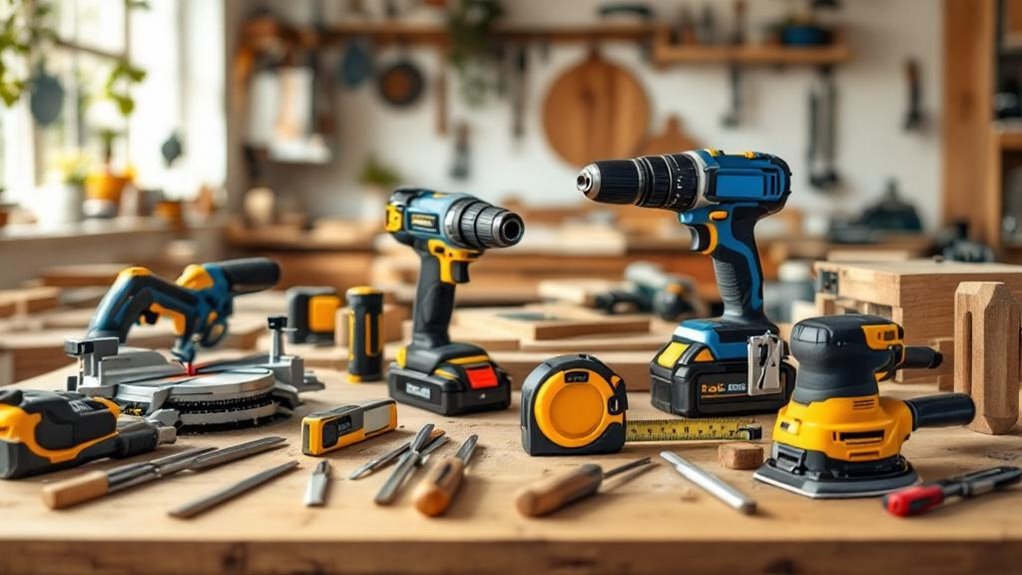
You can build a capable woodworking setup on any budget by starting with a tape measure, square, chisels, a claw hammer, and safety goggles, then adding a marking gauge, clamps, and a pocket hole jig for cleaner joinery. For power tools, a budget drill/driver, circular saw, random orbital sander, and jig saw cover most beginner projects. Under $30, grab a center punch, calipers, or a marking T-square, and you’ll quickly see which upgrades matter most.
Key Takeaways
- Start with basic hand tools: saw, chisels, tape measure, square, hammer, mallet, and safety goggles for essential DIY woodworking.
- Add precision tools like a marking gauge, center punch, machinist square, and digital calipers for accurate layout and joinery.
- Budget power tools under $100, such as a cordless drill, circular saw, jigsaw, and random orbital sander, cover most beginner projects.
- Use clamps, pocket hole jigs, and setup tools to align joints, hold work securely, and speed up assembly.
- Prioritize safety and organization with goggles, gloves, hearing protection, dust masks, pegboards, and labeled storage bins.
Best Woodworking Tools for Every Budget
Whether you’re just starting out or upgrading your workshop, the best woodworking tools for your budget are the ones that improve accuracy, safety, and efficiency without overspending.
You can build a strong setup with essential woodworking tools that fit nearly any price range. Under $30, a DEWENWILS wireless outlet saves time, and a Neiko digital caliper helps you measure parts precisely.
A solid woodworking setup starts with affordable essentials that boost accuracy, save time, and fit almost any budget.
Mid-range picks like the Powertec precision marking T square and Milescraft drill block improve layout and drilling consistency. If you tackle larger projects, a quality compound miter saw or table saw can deliver better cuts and smoother results.
Add a pocket hole jig for fast joinery, plus Dewalt safety goggles and sturdy clamps to keep your work safer and steadier.
First Woodworking Tools for Beginners
When you’re starting out, focus on essential starter tools that cover the basics: a crosscut saw, rip saw, a small chisel set, a measuring tape, a square, and a claw hammer.
Add a wooden or rubber mallet for safer chisel work, and wear safety goggles every time you use your tools.
These budget-friendly first picks give you the accuracy, control, and versatility you need without overbuying.
Essential Starter Tools
Your first woodworking toolkit should cover cutting, shaping, measuring, and assembly, starting with a crosscut saw and a rip saw for clean cuts across and along the grain.
These essential starter tools give you control on day one.
- Add a starter chisel set: ¼-inch, ½-inch, and 1-inch chisels let you carve joints, trim edges, and shape details precisely.
- Keep measuring tools nearby: a tape measure and square help you mark straight lines and true angles, so your work fits together right.
- Use a claw hammer and a wooden or rubber mallet: the hammer handles assembly tasks, while the mallet drives chisels without bruising their edges.
With these basics, you can practice accurate, confident woodworking and build cleaner projects from the start.
Budget-Friendly First Picks
A budget-friendly first woodworking toolkit starts with a hand saw, because it gives you a simple, reliable way to make both crosscuts and rip cuts without investing in power tools.
Add a starter set of chisels in ¼-inch, ½-inch, and 1-inch sizes so you can carve, shape, and clean up joints. A claw hammer helps you drive nails and take projects apart when you need to fix mistakes.
For accuracy, keep measuring tapes and squares close by; they help you mark straight lines and check proper angles before you cut.
Finish with a wood or rubber mallet, which lets you strike chisels safely without bruising the blade. These hand tools and precision tools give you a practical, low-cost foundation for solid woodworking.
Essential Hand Tools for Woodworking
You’ll want a basic set of hand tools that includes a hand saw, chisels in ¼-inch, ½-inch, and 1-inch sizes, a claw hammer, and a wooden or rubber mallet to handle most woodworking tasks.
For cutting, a crosscut saw works across the grain and a rip saw cuts with the grain, giving you the control you need for different jobs.
Use a measuring tape and square to mark accurate lengths and keep joints, edges, and corners lined up properly.
Essential Starter Hand Tools
A solid starter kit for woodworking begins with a few hand tools that cover cutting, shaping, measuring, and assembly. Your essential starter hand tools should include a hand saw, chisels, a claw hammer, a measuring tape, and a mallet.
A crosscut saw helps you cut across the grain, while a rip saw handles cuts along it.
- Use ¼-inch, ½-inch, and 1-inch chisels for shaping joints and trimming details.
- Reach for a sturdy measuring tape and a square when you need accurate dimensions and clean angles.
- Tap chisels with a wooden or rubber mallet so you don’t damage the tool or the workpiece.
With these basics, you can handle common DIY projects confidently and build a strong woodworking foundation.
Precision Marking And Layout
Once you’ve got your saws, chisels, and hammer in hand, the next step is getting every cut and hole marked with accuracy. For precision marking, use a marking gauge to keep repeat lines consistent and your joints tight.
A Neiko center punch with adjustable strike force helps you place drill points cleanly and stops bits from wandering. The Powertec 6 Precision Marking T Square gives you layout lines every 1/64 inch, which beats a basic speed square when you need tighter results.
Digital calipers, like the Neiko Electronic Digital Caliper, measure to one thousandth of an inch for exact dimensions. Finish your layout with a carpenter pencil from OX Tools, especially on dark wood, where its sharp tip stays visible.
Best Budget Power Tools for Woodworkers
When you’re building a starter workshop on a budget, focus on power tools that deliver solid results without draining your cash.
You can build a smart set of budget power tools and essential woodworking tools without overspending. Start with:
- RYOBI Cordless Drill/Driver Set under $100 for driving screws and drilling clean holes.
- RIDGID Cordless Circular Saw under $100 for straight cuts in lumber and sheet goods.
- RYOBI Random Orbital Sander around $60 for smooth, ready-to-finish surfaces.
Add a RYOBI Cordless Jig Saw for curved cuts, or a Cordless Brad Nailer under $100 to speed assembly and reduce hand-nailing strain.
A basic pocket hole jig, about $30, also helps you join furniture and cabinetry quickly.
Cheap Woodworking Tools That Save Time
You can speed up cleanup and keep your shop moving with cheap time-saving gadgets like the OSKOOL Automatic Vacuum Switch, which kicks on your vacuum with the tool and runs a bit longer after shutoff.
For fast setup, the Neiko Center Punch and Milescraft Drill Block help you mark holes accurately and drill square without extra measuring or rework.
When you need quicker material handling and cutting, the FivePears Panel Carrier and Amazon Basics Folding Utility Knife make plywood moves and trim cuts safer and faster.
Time-Saving Shop Gadgets
A few cheap shop gadgets can save you more time than another hand plane or clamp ever will. If you want time-saving tools, these options cut wasted motion and keep you working:
- The DEWENWILS wireless outlet lets you start dust collectors or tools from across the shop, so you’re not walking back and forth.
- The OSKOOL automatic vacuum switch runs your shop vac 10 seconds after a power tool stops, clearing dust before it settles.
- The FivePears panel carrier gives you one-handed control for plywood or MDF, making sheet handling safer and faster.
For repetitive drilling, the $8 Milescraft Drill Block keeps holes square.
The $7 Mouse Hand Sanding Pad speeds finish work on small parts with less fatigue.
Fast Setup Tools
With the Milescraft Drill Block, you can drill straight, perpendicular holes fast, so your assemblies fit right the first time. The Neiko Center Punch uses a spring-loaded tip to mark exact drill spots without a hammer, which speeds prep and improves precision marking.
The Powertec 6 Precision Marking T Square gives you reliable 90-degree references for quick, repeatable layout lines.
For cleanup, the OSKOOL Automatic Vacuum Switch turns on your vac when a tool stops, and the FivePears Panel and Plywood Carrier helps you move sheet goods one-handed.
These fast setup tools save minutes on every project and keep you focused.
Efficient Cutting Aids
Cheap cutting aids can shave real time off your workflow without eating into your budget. When you’re cutting wood, choose efficient cutting aids that match the job instead of forcing one tool to do everything.
- An $8 Amazon Basics Folding Utility Knife gives you a lightweight, quick-change option for trimming, scoring, and shop cleanup.
- A $20 Yonico 3/4 Radius Roundover Bit helps you make clean, finished edges on targeted projects without wasting material.
- A Milescraft Drill Block, also $8, keeps your holes perpendicular with hardened steel bushings, while a budget jigsaw like the RYOBI Cordless Jig Saw speeds curved cuts.
A miter saw adds angle accuracy for molding and furniture.
Measuring Tools That Keep Cuts Accurate
| Tool | Best Use | Benefit |
|---|---|---|
| Measuring tape | General layout | Straight, reliable measurements |
| Calipers | Fine details | Measures to 0.001 inch |
| Machinist square | Squareness checks | Durable and accurate |
| Digital calipers | Detailed parts | Four measurement types |
| T-square | Angle marking | Keeps 90-degree lines true |
Use them regularly, and your cuts’ll stay accurate.
Marking Tools for Cleaner Layouts
Accurate marking tools help you turn measurements into clean layout lines, so your cuts and joints fit the way you planned. Use a carpentry pencil, marking gauge, or T-square to place repeatable marks, and reach for a digital caliper when you need measurement accuracy down to a thousandth of an inch.
A reliable center punch can also mark drill spots fast, keep the bit from skidding, and help you work cleaner on hard surfaces.
Accurate Measurement Marks
Clean layouts start with clear marks, because even a slight error can throw off a cut or joint later on. You need marking tools that leave accurate measurement marks you can trust.
Carpenter pencils give bold, readable lines, while automatic center punches make crisp points for drilling starts. A marking gauge registers against the board edge and helps you repeat straight, consistent lines every time. For fine work, digital calipers can measure to one thousandth of an inch, so you can match parts precisely.
Use these steps: 1. Measure twice, 2. Mark once, 3. Score with a utility knife before cutting to reduce tear-out.
When you mark carefully, you’ll cut cleaner, fit joints better, and spend less time correcting mistakes.
Clean Layout Lines
Sharp layout lines are the difference between a project that fits together smoothly and one that needs sanding, trimming, or patching later. You can get there with the right marking tools.
A marking gauge helps you repeat the same offset for cuts and joinery, while calipers tighten up small dimensions before you saw. For dark stock, colored carpenter pencils stand out better, so you won’t miss your line.
When you need a precise drill start, a spring-loaded center punch marks the spot and keeps the bit from skating. A steel machinist square gives you durable, accurate reference edges.
Use these tools to guide clean cuts and keep every layout step readable, consistent, and fast.
Reliable Marking Tools
A marking gauge helps you carry the same distance from an edge, so every line stays parallel. Colored carpenter pencils show up well on dark wood and still hold on rough or finished surfaces. For drilling, a center punch like the Neiko model stops bits from skidding on hardwood or metal.
A T-square gives you true 90-degree references, and electronic calipers help when you need thousandths of an inch.
- Marking gauge
- Center punch
- T-square
Clamps and Holders for Safer Builds
When you’re assembling woodworking projects, clamps and holders do more than save time—they keep pieces from shifting so your cuts, joints, and angles stay accurate.
For safer builds, clamps, tools are essential because they let you work hands-free and keep parts aligned while glue sets.
Use right angle clamps when you need a true 90-degree corner, and reach for quick-release clamps when you want fast setup and removal.
F-clamps and C-clamps handle different thicknesses and shapes, so they’re useful for boards, jigs, and odd layouts.
For larger projects, pipe clamps give you more reach, while small spring clamps help with temporary holds.
Mixing these tools improves control, reduces mistakes, and makes every assembly steadier and safer.
Cutting Tools That Work on a Budget
When you’re cutting on a budget, a lightweight utility knife like the $8 Amazon Basics Folding Utility Knife gives you quick blade changes and enough control for many DIY jobs.
If you need more precision, tools like the $15 Neiko Center Punch, the $8 Milescraft Drill Block, and the $25 Neiko Digital Caliper help you mark, drill, and measure accurately before you cut.
For edge work, a $20 Yonico 3/4 Radius Roundover Bit can give you clean, professional-looking results without pushing your tool budget too far.
Budget Blades and Knives
Sharp cuts don’t have to come with a sharp price tag. For budget blades and knives, you can keep your workshop efficient with a few smart picks. The Amazon Basics Folding Utility Knife costs $8, feels light in your hand, and uses quick-change blades, so you can switch tasks fast.
Keep one near your cutting board for trimming veneer, opening stock, or cleaning up marks.
- Utility knives: cheap, versatile, and easy to replace.
- Neiko Center Punch: at $15, it helps you mark holes cleanly before drilling.
- Yonico 3/4 Radius Roundover Bit: for $20, it gives you smooth edges on occasional projects.
These tools won’t drain your budget, but they’ll help you work faster and cleaner.
Precise Cuts on a Budget
The Milescraft drill block gives you perpendicular drilling in a compact, $8 package, so your joints and hardware land where they should. For measuring, the Neiko digital caliper reads to one thousandth of an inch, which helps you chase precision cuts on detailed parts.
When you need a versatile cutter, the Amazon Basics folding utility knife is one of the best affordable options. For shaping edges, the Yonico roundover bit delivers clean results without a big spend.
Sanding Tools for Smooth Finishes
Sanding tools are key to turning rough wood into a smooth, professional-looking finish, and the right setup can save you a lot of time and effort.
You’ll get better results with:
- Random orbital sanders for fast, even removal on larger surfaces.
- A 5-inch mouse hand sanding pad for tight spots and small parts.
- Grit progressions from 80-120 up to 220 or finer for a ready-to-finish surface.
Start coarse to knock down imperfections, then move finer to refine the wood. Electric sanding machines cut your manual labor and speed up the job, while hand sanding gives you control where detail matters.
Keep your sanding tools clean and use the right sandpaper for the task so they last longer and keep delivering professional finishes on every project.
Dust Control Tools for a Cleaner Shop
Keeping your shop clean isn’t just about appearances—it’s a major part of safe, efficient woodworking. You can control fine debris with shop vacuums, a dedicated dust collector, and an automatic switch like the OSKOOL unit, which turns on your vacuum when you start a tool.
That immediate dust collection helps you keep cleaner air quality and reduces the buildup that can clog motors and slow your workflow. A good dust collector can capture up to 99% of airborne particles and handle multiple machines, so it’s ideal if you work on bigger projects.
You should also clean filters and empty bags regularly to keep performance high. With consistent maintenance, your tools run better, and your shop stays healthier and more productive.
Safety Gear Every Woodworker Needs
A safe shop starts with the right gear, and there are a few essentials you shouldn’t skip. Start with safety goggles; ANSI-rated, anti-fog pairs protect your eyes from chips and debris.
Next, use hearing protection to block the steady noise from power tools. A dust mask or respirator also matters because it filters fine wood dust and keeps your lungs safer.
- Safety goggles for full eye coverage
- Cut-resistant gloves for hand protection and dexterity
- Hearing and dust protection for longer sessions
Add an apron or safety vest if you want pockets for small accessories and a bit more protection.
When you gear up every time, you work more confidently and reduce avoidable injuries.
Setup Tools That Improve Precision
Precision starts with the tools you use to set up your work, and a few smart choices can make your joints, cuts, and layouts far more accurate. When you rely on setup tools, you cut guesswork and boost precision fast. Use Kagyifly setup bars for clean alignment, a Powertec 6 Precision Marking T Square for repeatable marks, and Neiko digital calipers when you need thousandth-of-an-inch readings. A 3″ machinist square keeps your assemblies true, while an automatic center punch marks holes without a hammer.
| Tool | Best Use | Benefit |
|---|---|---|
| Setup bars | Joint setup | Accurate alignment |
| Marking T square | Layout lines | Repeatable marks |
| Digital calipers | Fine measuring | Exact dimensions |
Woodworking Shop Organization Tools
An organized shop helps you work faster and safer because your tools, hardware, and materials stay within easy reach. The best workshop organization tools make every task smoother, especially when you’re building a setup around woodworking tools for beginners.
Use these:
- Pegboards and shelving systems to keep hand tools visible and off the bench.
- Toolboxes or storage carts to move essentials where you need them and cut clutter.
- Adjustable lumber racks, like a Kastforce-style rack, to save floor space and stack supplies vertically.
Label bins and shelves so you grab screws, clamps, or finish fast.
Add a dedicated workbench with integrated storage for a stable work area and smart tool holders. When you organize well, you spend less time searching and more time building.
Best Budget Jigs for Repeat Cuts
For repeat cuts without overspending, a few smart jigs can make your DIY work faster, cleaner, and more accurate. Pocket hole jigs are great budget jigs when you need strong hidden joints with minimal setup.
The Kreg Mini Pocket Hole Jig costs about $40, so you can move it between projects and work in tight spots. If you want more versatility, the Kreg Jig K4 Master System runs around $100 and helps you make quick, precise repeat cuts on bigger builds.
You can also use a jigsaw with a guided cutting jig attachment for consistent curves and angles. For table saw work, build a simple crosscut sled for less than $25 and boost accuracy every time.
Handy Workshop Accessories Under $30
Once your repeat-cut jigs are set, a few low-cost accessories can make the rest of the shop run smoother and safer.
For DIY projects, these handy workshop accessories punch above their price:
- FivePears Panel and Plywood Carrier — At $25, you can move ¾-inch sheets up to 200 lbs one-handed, which saves your back when hauling plywood or MDF.
- Dewalt Safety Goggles — For $10, you get anti-fog eye protection that works with over-ear hearing protection, so you can keep cutting without constant adjustments.
- Powertec 6 Precision Marking T Square — At $25, its T-fence and 1/64-inch marking holes help you lay out accurate 90-degree lines fast.
Add the Neiko digital caliper or squeeze glue bottles if you want even tighter measuring and cleaner glue-ups.
Which Woodworking Tools to Upgrade First
If you’re deciding which woodworking tools to upgrade first, start with the ones that save you the most time and widen the range of jobs you can tackle.
A quality drill/driver set should come first, since you’ll use it for drilling, fastening, and furniture assembly.
Next, upgrade to a table saw if you’re ready for larger builds; it gives you faster, more accurate rip cuts and handles sheet goods better.
For cleaner angle work, a compound miter saw is worth adding before you struggle through trim and molding cuts.
A random orbit sander also pays off by speeding up prep and improving finishes.
If you often join boards, a pocket hole jig makes assembly quicker and stronger.
A drill press helps when you need repeated, straight holes.
Building Your Tool List by Budget
A smart woodworking tool list starts with your budget, and you can build one in stages without overspending.
Start with essential tools that cover the basics, then add power tools as projects grow.
- Under $50: buy a hand saw, chisels, and a measuring tape. These essential tools handle layout, cuts, and shaping for beginner projects.
- Around $30 extra: add a utility knife and safety goggles. You’ll cut cleaner and stay protected while you work.
- $50 to $100: upgrade to a cordless drill/driver set and a circular saw. These power tools let you build faster and tackle larger DIY jobs.
Don’t forget pegboards and tool boxes.
Good organization keeps your workspace efficient, protects your gear, and helps you find what you need quickly.
Frequently Asked Questions
What Tool Brands Offer the Best Warranty for DIY Woodworkers?
You’ll often get the best warranties from Festool, Makita, Bosch, and DeWalt. Check each tool’s specific terms, because coverage varies, but these brands usually offer solid service, fast repairs, and dependable parts support.
How Should I Maintain Woodworking Tools to Extend Their Lifespan?
You should clean dust off after each use, oil metal parts regularly, sharpen blades often, store tools dry, tighten loose fasteners, inspect cords, and replace worn parts promptly so they’ll last longer and perform better.
Which Cordless Tool Battery Platform Is Most Cost-Effective?
You’re usually best off choosing the battery platform with the widest tool lineup and frequent sales; it keeps your costs down like owning one key for many doors. Compare battery prices, warranties, and charger bundles before buying.
What Woodworking Tools Are Best for Small Apartment Workshops?
You’ll want compact, quiet tools: a cordless drill/driver, jigsaw, random orbital sander, compact circular saw, hand plane, chisels, and a folding workbench. They handle most projects, store easily, and won’t overwhelm your apartment.
How Do I Choose Between Corded and Cordless Woodworking Tools?
Choose corded tools when you need nonstop power for heavy cuts; choose cordless tools when you value portability and quick setups. You’ll likely want corded for shop work, cordless for tight spaces, outdoor jobs, or convenience.
Conclusion
No matter your budget, the right woodworking tools help you build with confidence, accuracy, and less waste. Start with the essentials, add budget-friendly power tools, and upgrade the tools you use most often. A sharp chisel, a solid drill, and a reliable saw can turn rough lumber into real results. In woodworking, every good tool is a stepping stone, and every project teaches you what to buy next.