
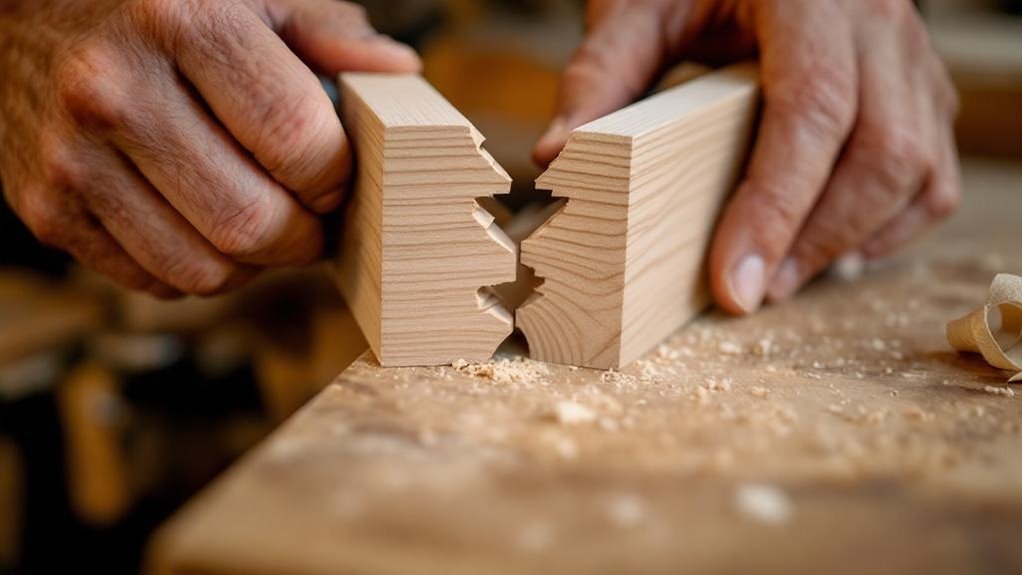
You should choose dovetails when you need lasting mechanical strength, visible craftsmanship, and higher resale value despite added time and skill. Use them for drawers, boxes, and prominent joints where glue alone won’t hold up to repeated use. Set up a stable bench, sharp saws and chisels, and mark grain directions carefully for tight fits. Handcut gives bespoke character; jigs speed repeatability. Keep simple fixes ready for fit issues, and continue to learn the detailed steps and tips.
Key Takeaways
- Use dovetails when joint strength, longevity, and visible craftsmanship justify extra time, such as in drawers, boxes, and heirloom furniture.
- Choose handcut dovetails for bespoke aesthetics and fine tuning; use jigs for speed and repeatability in production runs.
- Prefer half-blind dovetails when you need a clean front face, and through dovetails when decorative strength is acceptable.
- Ensure proper tools and setup—sharp chisels, a fine dovetail saw, marker, stable bench, and good lighting—to minimize errors.
- Fix fit issues by cleaning debris, shaving tight areas, gluing minor gaps, or planing uneven pieces before final assembly.
When to Choose Dovetail Joints: Quick Checklist
Wondering whether a dovetail is the right joinery for your project? You’ll pick dovetail joints when strength and longevity matter—drawers and boxes that see daily use benefit most.
Choose half-blind dovetails when a clean front matters; they hide the pins for furniture faces. Use through dovetails when you want both visible character and robust mechanical strength, ideal for decorative boxes or cases.
Consider sliding dovetails to join shelves or structural components where a concealed, secure connection replaces fasteners. Favor dovetails for woodworking projects that aim for lasting craftsmanship and reduced reliance on glue or screws, since they add value and durability.
If your project prioritizes aesthetics, wear, or permanence, dovetails are worth the extra effort.
Essential Tools and Workshop Setup for Accurate Dovetails
Now that you know when dovetails are the right choice, set yourself up to cut them accurately by collecting the right tools and organizing your workspace. You’ll need essential tools: a dovetail saw for fine, accurate cuts, a dovetail marker for consistent angles, and sharp chisels to pare sockets cleanly. Add a coping saw to remove waste and a secure vice on a flat surface. Good workshop setup—stable bench, bright lighting, and reachable tools—reduces errors and fatigue.
| Tool | Purpose | Tip |
|---|---|---|
| Dovetail saw | Accurate cutting | Use fine teeth, steady strokes |
| Sharp chisels | Clean sockets | Keep edges honed |
| Dovetail marker | Consistent angles | Mark once, cut once |
| Coping saw | Waste removal | Cut close, finish with chisel |
Wood, Grain, and Layout Tips for Tight-Fitting Dovetails
Choose quarter‑sawn boards when you can; their straight, predictable grain reduces tear‑out and stabilizes the pins and tails.
Always mark with the grain so your layout and saw cuts align with the wood’s direction, giving cleaner faces and tighter fits.
Test‑fit after cutting and adjust your layout lines as needed to achieve a snug, consistent joint.
Choose Quarter-Sawn Boards
Because quarter-sawn boards run straighter and move less across their width, pick them when you want dovetails that stay tight and cut clean, with minimal tear-out. You’ll get straighter grain, enhanced ray flecks, and reduced movement so your dovetail joints hold their fit over time. In layout planning, account for the board’s minimal across-grain expansion so your fitting joint won’t loosen. When cutting, align your saw and chisel with the grain to preserve edge integrity and make cleanup predictable.
| Benefit | Effect |
|---|---|
| Straight grain | Predictable cuts |
| Reduced movement | Long-lasting fit |
| Less tear-out | Cleaner edges |
| Ray flecks | Visual character |
Choose quarter-sawn boards to make your dovetails precise and reliable.
Mark With The Grain
Grain direction should guide every layout line you make for dovetails, so inspect the board first and align your marker, bevel, and measurements with the fibers to minimize chipping and secure cleaner sawing and paring.
You should always mark with the grain: orient your dovetail marker to follow the pattern so lines sit on the face grain rather than across end grain. That choice makes cutting dovetails and subsequent chiseling cleaner and reduces tear-out.
Transfer measurements consistently along the grain to preserve joint features and facilitate tighter assembly. Lay cut lines clearly in the waste areas so they guide sawing without compromising visible surfaces.
Machine-Cut Dovetails: Step-by-Step Workshop Tutorial
Set up your jig and clamp the workpieces firmly, then double-check alignment so the router follows the template precisely; machine-cut dovetails rely on that secure registration and consistent board thickness to produce tight, repeatable pins and tails. Use a quality dovetail jig (Leigh-style) and a sharp bit, confirm board faces are flat and thicknesses uniform, then cut test pieces. Adjust the template for half-blind or through dovetails as needed. Maintain bit sharpness and verify jig settings between runs to keep joint fits consistent. Routinely clean and inspect the jig for play. Work methodically: clamp, set depth, run the router, flip and repeat, then dry-assemble to confirm fit before final glue-up.
| Checkpoint | Action |
|---|---|
| Clamping | Secure both boards |
| Alignment | Verify template registration |
| Bit | Inspect/sharpen |
| Test fit | Dry-assemble |
Handcut vs. Jig Dovetails: Method, Speed, and Best Uses
When you handcut dovetails you get precise, customizable joints that show your skill and let you tweak angles and spacing for a perfect fit.
If you need speed and repeatability, a jig gives consistent results across many pieces in a fraction of the time.
Choose handcut for bespoke, visible work and jigging for production runs where uniformity and efficiency matter.
Handcut Precision Benefits
Precision matters most when you’re aiming for a tailored fit, and handcut dovetails give you control that jigs can’t match.
When you cut handcut dovetails, you refine mating surfaces to the irregularities of the stock, dialing in precision that improves mechanical lock and aligns with fine woodworking joints standards.
You’ll notice the difference in how parts seat and how edges reflect light—subtle aesthetics that signal craftsmanship.
It takes skill and time, but you can pare, test-fit, and tweak on the fly to achieve a bespoke result that machines rarely produce.
Choose handcut work when your project rewards individuality, when woods vary, or when you want the satisfaction of mastering a traditional joinery technique that elevates both function and form.
Jig Speed And Consistency
Often the fastest way to crank out a dozen matching drawers is with a dovetail jig, since it lets you rout identical pins and tails in minutes rather than hours. You’ll appreciate how dovetail jigs standardize layout and make complex pin and tail patterns repeatable, cutting setup time and reducing mistakes.
For production or when consistency matters, a jig boosts throughput and is easier to cut for novices than hand methods. The Pros and Cons are straightforward: jigs favor speed and predictability, handcutting offers customization and craft expression.
Choose jigs for scale, tight schedules, or when uniformity matters; choose handcuts when aesthetic nuance or skill development is the priority. Balance practicality with the look you want.
Fixing Common Dovetail Fit Problems Quickly
Start by identifying the specific fit problem—loose, tight, misaligned, or dirty—so you can apply the quickest, least invasive fix.
For fixing common dovetail joints issues, clean debris first; removing sawdust often solves binding or poor seating.
For loose joints, spread wood glue thinly and evenly between pins and tails, clamp and wipe squeeze-out.
For tight fits, shave with a sharp chisel or sand mating faces lightly until parts slide together without play.
If misaligned parts come from uneven board widths, plane to uniform thickness and square ends before reassembly.
To prevent recurrence, check dovetail jig settings, secure templates before cutting tails, and adopt these practical tips and tricks: measure twice, cut once, and keep cutter paths clean for repeatable accuracy.
When Dovetails Are Worth the Time and Cost
Strength and longevity make dovetails worth the extra time when you’re building pieces that will see heavy use or represent your workmanship—think drawers, heirloom boxes, or saleable furniture—because they resist racking and looseness without relying solely on glue or fasteners.
You’ll choose dovetail joints when durability and appearance matter: they deliver mechanical strength for frequent use and a visible sign of craftsmanship that buyers value in furniture making.
Cutting accurate pins into a clean pin board and matching tails reinforces weak butt or rabbet connections, raising overall structural integrity. Yes, they take skill and time, but reduced dependence on adhesives, improved load resistance, and marketplace credibility make them a smart investment for critical joinery.
Frequently Asked Questions
What Are Common Dovetail Joint Mistakes?
You commonly misalign pins and tails, skip using a dovetail marker, neglect test fits, rush cutting/assembly, and work with dull tools; these mistakes cause gaps, uneven profiles, difficult adjustments, weak joints, and poor aesthetics.
What Is the Weakness of a Dovetail Joint?
Its weaknesses are precision-dependent, labor-intensive, and hard to disassemble: you’ll need skilled cutting, significant time, and careful grain consideration, or you’ll face misalignment, looseness, seasonal gaps, and costly repairs or modifications.
Are Dovetail Jigs Worth the Investment?
Yes — you’ll get consistent, precise dovetails faster, reduce mistakes, and achieve professional results; a high-quality jig pays off if you’ll build multiple drawers or boxes, though occasional hobbyists might not justify the expense.
How Tight Should Dovetails Be?
They should be snug but not forced; you’ll aim for virtually no gap (about 1/64 inch max) so the joint’s strong yet allows wood movement. Test on scraps, adjust cutters, and clamp evenly without overpressuring.
Conclusion
Dovetails pay off when strength and appearance matter: they resist racking and glue failure better than butt joints, and studies show properly cut dovetails increase joint tensile strength by up to 30%. You’ll choose them for heirloom drawers, high-use cabinets, or pieces where the joint is a feature. With the right tools and practice, you’ll get fast, repeatable results. Invest the extra time where longevity and craftsmanship justify the cost.